Academic Winner

Hot

Post Top Ad

International Anti-Corruption Day observed on 9 December

08:44:00
International Anti-Corruption Day was observed by the United Nations on 9 December 2014. The day was observed to raise public awareness about corruption and what people can do to fight it.

The theme of 2014 International Anti-Corruption Day was Break the Corruption Chain. The theme focused on showing the importance of individual engagement in tackling a phenomenon that strikes hardest at the poor, hinders inclusive economic growth and robs essential services of badly needed funds.
On the theme a joint international campaign called Break the Corruption Chain was launched to focus on how corruption undermines democracy and the rule of law, leads to human rights violations, distorts markets, erodes quality of life and allows organized crime, terrorism and other threats to human security to flourish.

About International Anti-Corruption Day

On 31 October 2003, UN General Assembly (UNGA) adopted the United Nations Convention against Corruption and designated the United Nations Office on Drugs and Crime (UNODC) as secretariat for the Convention against corruption.
The UNGA also designated 9 December as International Anti-Corruption Day. The Convention entered into force in December 2005.

Read More

Top 5 things Satyarthi said at Nobel ceremony

08:34:00
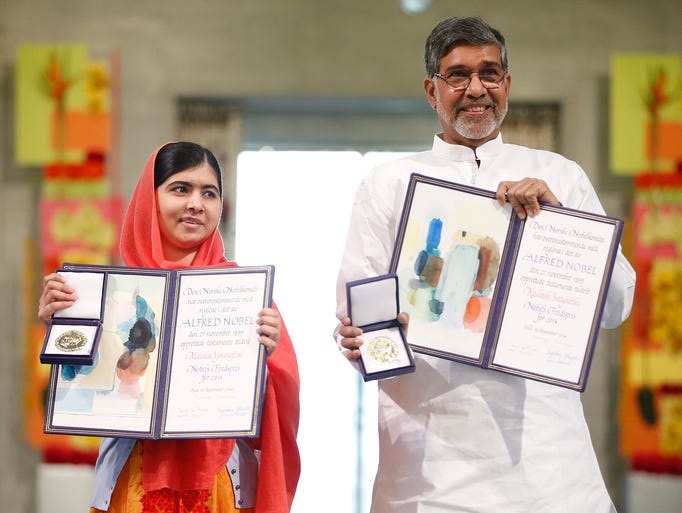
Child rights campaigner Kailash Satyarthi and Malala Yousafzai, the youngest ever Nobel laureate, received the Nobel peace prize on Wednesday. Satyarthi, 60, is recognized for a 35-year battle to free thousands of children from virtual slave labour.

Here are top five things that Satyarthi said in his acceptance speech.

1.Children are questioning our inaction and watching our action.

2.My dream is to make every child free to develop ... There is no greater violence than to deny the dreams of children.

3.Recounting his experience with the unprivileged people, he said, "I am representing the sound of silence of millions of children who are left behind."

4."The credit to this honour goes to people who worked and sacrificed for freeing children," he said.

5."I've lost two of my colleagues," Satyarthi said about his work. "Carrying the dead body of a colleague who is fighting for the protection of children is something I'll never forget, even as I sit here to receive the Nobel Peace Prize."
Read More

Kailash Satyarthi, Malala receive Nobel peace prize

08:30:00
Child rights campaigner Kailash Satyarthi and Malala Yousafzai, the youngest ever Nobel laureate, received the Nobel peace prize on Wednesday.

Satyarthi, 60, is recognized for a 35-year battle to free thousands of children from virtual slave labour while 17-year-old Malala became a global icon after she was shot and nearly killed by the Taliban for insisting that girls had a right to an education.

Malala has already been honoured with a host of awards, standing ovations and plaudits everywhere from the United Nations to Buckingham Palace.
 But on the eve of the ceremony she said she would not rest on her laurels, saying she would like one day to become prime minister in her native Pakistan.

"If I can serve my country best through politics and through becoming a prime minister then I would definitely choose that," she told the BBC.

"I want to serve my country and my dream is that my country becomes a developed country and I see every child get an education."

At a press conference Tuesday in Oslo, Malala said that in many parts of the world, children's requirements are infinitely more modest than an "iPad or computer."

"What they are asking for is just a book, just a pen, so why can't we do that?"

Malala was 15 when a Taliban gunman shot her in the head as she travelled on a school bus in response to her campaign for girls' education.

Although she almost died, she recovered after being flown for extensive surgery in Birmingham, central England.

She has been based in the city with her family ever since, continuing both her education and activism.

For the first time ever the blood-soaked school uniform she wore when she was shot near her home in the Swat Valley in October 2012 will go on display at the Nobel Peace Centre in Oslo this week.

Asked why she thinks some Islamic extremist groups are so opposed to education for girls, Malala, dressed in a multi-coloured headscarf, replied: "Unfortunately, those people who stand against education, they sometimes themselves are uneducated or they've been indoctrinated".

The pairing of Malala and Satyarthi had the extra symbolism of linking neighbouring countries that have been in conflict for decades.

After she was named as the winner, Malala said she wanted both states' prime ministers to attend the prize-giving ceremony in Oslo.

"If the prime ministers had come here I would have been very happy," she said. "I would have thought of it as a big opportunity to ask them ... to make education their top priority and work on it together because we see the number of children who are out of school and suffering from child labour are mostly in India and Pakistan."

While Malala will be the star of the annual Nobels extravaganza — also featuring the literature prize winner, Frenchman Patrick Modiano, and his compatriot Jean Tirole with the economics award — her peace prize co-winner Satyarthi is less high-profile.

He welcomed the increased attention the Nobel brought to the cause of children in bonded labour.

"There are children who are bought and sold like animals," the jovial 60-year-old, clad in traditional Indian dress, told reporters at the Nobel Institute.


"This is very important for millions and millions of children who are denied their childhood, who are denied their freedom, who are denied their education and health," he said, adding that the peace prize had shone a spotlight on their plight.

Satyarthi's organization Bachpan Bachao Andolan (Movement to Save Childhood) prides itself on liberating more than 80,000 children from bonded labour in factories and workshops across India and has networks of activists in more than 100 countries.

According to the International Labour Organization (ILO) there are about 168 million child labourers globally.

Nobel winners receive eight million Swedish kronor ($1.1 million, 862,000 euros), which is shared in the case of joint wins.
Read More

RBI notifies new FDI policy for defence, railways

08:17:00
The Reserve Bank today notified the government's decision to increase foreign investment ceiling in defence sector and permitting 100 per cent FDI in railways infrastructure. After assuming power, the NDA government has reviewed Foreign Direct Investment (FDI) policy for railways sector as well as defence.

Government has permitted 100 per cent FDI in railway infrastructure sector under the automatic route subject to conditions. In the defence sector, foreign investment (FDI, FIIs, RFPIs, NRIs, FVCIs and QFIs) up to 49 per cent has been permitted under government route (FIPB) in the defence sector. The earlier cap was 26 per cent.

As per the revised policy for defence sector, portfolio investment (RFPI/FII/NRI/QFI) and FVCI investment will not exceed 24 per cent of the total equity of the investee company. Portfolio investment will be under the automatic route. In the railway segment, FDI will be allowed in construction, operation and maintenance of suburban corridor projects through PPP, high speed train projects and dedicated freight lines.

FDI has also been allowed in rolling stock including train sets, and locomotives/coaches manufacturing and maintenance facilities, railway electrification, signaling systems, freight terminals and passenger terminals, among others.

As per the policy for railway sector, FDI beyond 49 of the equity of the investee company in sensitive areas from security point of view will be brought before the Cabinet Committee on Security (CCS) for consideration on a case to case basis.

The Reserve Bank today notified the government's decision to increase foreign investment ceiling in defence sector and permitting 100 per cent FDI in railways infrastructure. After assuming power, the NDA government has reviewed Foreign Direct Investment (FDI) policy for railways sector as well as defence. Government has permitted 100 per cent FDI in railway infrastructure sector under the automatic route subject to conditions. In the defence sector, foreign investment (FDI, FIIs, RFPIs, NRIs, FVCIs and QFIs) up to 49 per cent has been permitted under government route (FIPB) in the defence sector. The earlier cap was 26 per cent. As per the revised policy for defence sector, portfolio investment (RFPI/FII/NRI/QFI) and FVCI investment will not exceed 24 per cent of the total equity of the investee company. Portfolio investment will be under the automatic route. In the railway segment, FDI will be allowed in construction, operation and maintenance of suburban corridor projects through PPP, high speed train projects and dedicated freight lines. FDI has also been allowed in rolling stock including train sets, and locomotives/coaches manufacturing and maintenance facilities, railway electrification, signaling systems, freight terminals and passenger terminals, among others.

Read more at: http://www.moneycontrol.com/news/business/rbi-notifies-new-fdi-policy-for-defence-railways-infra_1247720.html?utm_source=ref_article
Read More

Post Top Ad